 Add to Chrome
 Add to Firefox
 Add to Edge
SeClaw: Spec-Driven Security Task Synthesis for Evaluating Autonomous Agents
Jun 01, 2026
Autonomous LLM agents increasingly operate in stateful environments where they access tools, files, memory, and external services. While such capabilities enable complex real-world workflows, they also introduce security risks that are difficult to capture with existing evaluations. Current agent security benchmarks often rely on manually curated tasks, provide limited coverage of emerging threats, and focus primarily on final outcomes rather than the execution processes that lead to unsafe behavior. We introduce SeClaw, a framework that combines specification-driven security task synthesis with execution-based security evaluation for Autonomous agents. Spec-driven security task synthesis enables scalable and controllable construction of security tasks from structured risk specifications, while SeClaw docker provides a standardized testbed for evaluating agent behavior under diverse safety-risk scenarios. The benchmark covers risks arising from resources, user tasks, environments, and intrinsic agent behaviors, and supports trajectory-aware assessment of unsafe actions beyond final responses. By bridging systematic task synthesis and reproducible security evaluation, SeClaw provides a practical foundation for measuring, diagnosing, and comparing security failures in autonomous LLM agents. The code is available at https://github.com/seclaw-eval/seclaw-eval.

DEFLECT: Delay-Robust Execution via Flow-matching Likelihood-Estimated Counterfactual Tuning for VLA Policies
May 19, 2026Vision-Language-Action (VLA) policies are typically deployed with asynchronous inference: the robot executes a previously predicted action chunk while the model computes the next one. This creates a prediction-execution misalignment: the chunk is conditioned on the observation taken before inference began, but executes in a physical state that has already drifted forward by several control steps; naive asynchronous rollover collapses from 89% to under 1% on Kinetix as the inference cycle covers up to seven control steps. We introduce DEFLECT, a fully offline post-training refinement that applies as a near drop-in upgrade to existing async-VLA stacks by converting latency itself into a label-free preference signal: counterfactual fresh/stale action pairs are constructed from a frozen reference policy and scored under the deployment-time conditioning via an implicit flow-matching likelihood-ratio surrogate, with no human labels, reward models, or online rollouts. DEFLECT substantially extends the usable delay envelope of async VLA control, with +6.4 success-rate gain in the high-latency regime (5-7 control steps), +4.6 when transferred to a real-scale VLA at the longest delay, and consistent improvements on two real-robot tasks (a bimanual conveyor pick-and-place and a reactive whack-a-mole).
What Limits Vision-and-Language Navigation ?
May 13, 2026Vision-and-Language Navigation (VLN) is a cornerstone of embodied intelligence. However, current agents often suffer from significant performance degradation when transitioning from simulation to real-world deployment, primarily due to perceptual instability (e.g., lighting variations and motion blur) and under-specified instructions. While existing methods attempt to bridge this gap by scaling up model size and training data, we argue that the bottleneck lies in the lack of robust spatial grounding and cross-domain priors. In this paper, we propose StereoNav, a robust Vision-Language-Action framework designed to enhance real-world navigation consistency. To address the inherent gap between synthetic training and physical execution, we introduce Target-Location Priors as a persistent bridge. These priors provide stable visual guidance that remains invariant across domains, effectively grounding the agent even when instructions are vague. Furthermore, to mitigate visual disturbances like motion blur and illumination shifts, StereoNav leverages stereo vision to construct a unified representation of semantics and geometry, enabling precise action prediction through enhanced depth awareness. Extensive experiments on R2R-CE and RxR-CE demonstrate that StereoNav achieves state-of-the-art egocentric RGB performance, with SR and SPL scores of 81.1% and 68.3%, and 67.5% and 52.0%, respectively, while using significantly fewer parameters and less training data than prior scaling-based approaches. More importantly, real-world robotic deployments confirm that StereoNav substantially improves navigation reliability in complex, unstructured environments. Project page: https://yunheng-wang.github.io/stereonav-public.github.io.
Morphology-Consistent Humanoid Interaction through Robot-Centric Video Synthesis
Mar 20, 2026Equipping humanoid robots with versatile interaction skills typically requires either extensive policy training or explicit human-to-robot motion retargeting. However, learning-based policies face prohibitive data collection costs. Meanwhile, retargeting relies on human-centric pose estimation (e.g., SMPL), introducing a morphology gap. Skeletal scale mismatches result in severe spatial misalignments when mapped to robots, compromising interaction success. In this work, we propose Dream2Act, a robot-centric framework enabling zero-shot interaction through generative video synthesis. Given a third-person image of the robot and target object, our framework leverages video generation models to envision the robot completing the task with morphology-consistent motion. We employ a high-fidelity pose extraction system to recover physically feasible, robot-native joint trajectories from these synthesized dreams, subsequently executed via a general-purpose whole-body controller. Operating strictly within the robot-native coordinate space, Dream2Act avoids retargeting errors and eliminates task-specific policy training. We evaluate Dream2Act on the Unitree G1 across four whole-body mobile interaction tasks: ball kicking, sofa sitting, bag punching, and box hugging. Dream2Act achieves a 37.5% overall success rate, compared to 0% for conventional retargeting. While retargeting fails to establish correct physical contacts due to the morphology gap (with errors compounded during locomotion), Dream2Act maintains robot-consistent spatial alignment, enabling reliable contact formation and substantially higher task completion.
Shifting Uncertainty to Critical Moments: Towards Reliable Uncertainty Quantification for VLA Model
Mar 18, 2026Vision-Language-Action (VLA) models enable general-purpose robotic policies by mapping visual observations and language instructions to low-level actions, but they often lack reliable introspection. A common practice is to compute a token-level uncertainty signal and take its mean over a rollout. However, mean aggregation can dilute short-lived but safety-critical uncertainty spikes in continuous control. In particular, successful rollouts may contain localized high-entropy segments due to benign noise or non-critical micro-adjustments, while failure rollouts can appear low-entropy for most timesteps and only exhibit brief spikes near the onset of failure. We propose a unified uncertainty quantification approach for predicting rollout success versus failure that (1) uses max-based sliding window pooling to preserve transient risk signals, (2) applies motion-aware stability weighting to emphasize high-frequency action oscillations associated with unstable behaviors, and (3) performs DoF-adaptive calibration via Bayesian Optimization to prioritize kinematically critical axes. Experiments on the LIBERO benchmark show that our method substantially improves failure prediction accuracy and yields more reliable signals for failure detection, which can support downstream human-in-the-loop interventions.
UniGround: Universal 3D Visual Grounding via Training-Free Scene Parsing
Mar 09, 2026Understanding and localizing objects in complex 3D environments from natural language descriptions, known as 3D Visual Grounding (3DVG), is a foundational challenge in embodied AI, with broad implications for robotics, augmented reality, and human-machine interaction. Large-scale pre-trained foundation models have driven significant progress on this front, enabling open-vocabulary 3DVG that allows systems to locate arbitrary objects in a given scene. However, their reliance on pre-trained models constrains 3D perception and reasoning within the inherited knowledge boundaries, resulting in limited generalization to unseen spatial relationships and poor robustness to out-of-distribution scenes. In this paper, we replace this constrained perception with training-free visual and geometric reasoning, thereby unlocking open-world 3DVG that enables the localization of any object in any scene beyond the training data. Specifically, the proposed UniGround operates in two stages: a Global Candidate Filtering stage that constructs scene candidates through training-free 3D topology and multi-view semantic encoding, and a Local Precision Grounding stage that leverages multi-scale visual prompting and structured reasoning to precisely identify the target object. Experiments on ScanRefer and EmbodiedScan show that UniGround achieves 46.1\%/34.1\% Acc@0.25/0.5 on ScanRefer and 28.7\% Acc@0.25 on EmbodiedScan, establishing a new state-of-the-art among zero-shot methods on EmbodiedScan without any 3D supervision. We further evaluate UniGround in real-world environments under uncontrolled reconstruction conditions and substantial domain shift, showing training-free reasoning generalizes robustly beyond curated benchmarks.
T2MBench: A Benchmark for Out-of-Distribution Text-to-Motion Generation
Feb 14, 2026Most existing evaluations of text-to-motion generation focus on in-distribution textual inputs and a limited set of evaluation criteria, which restricts their ability to systematically assess model generalization and motion generation capabilities under complex out-of-distribution (OOD) textual conditions. To address this limitation, we propose a benchmark specifically designed for OOD text-to-motion evaluation, which includes a comprehensive analysis of 14 representative baseline models and the two datasets derived from evaluation results. Specifically, we construct an OOD prompt dataset consisting of 1,025 textual descriptions. Based on this prompt dataset, we introduce a unified evaluation framework that integrates LLM-based Evaluation, Multi-factor Motion evaluation, and Fine-grained Accuracy Evaluation. Our experimental results reveal that while different baseline models demonstrate strengths in areas such as text-to-motion semantic alignment, motion generalizability, and physical quality, most models struggle to achieve strong performance with Fine-grained Accuracy Evaluation. These findings highlight the limitations of existing methods in OOD scenarios and offer practical guidance for the design and evaluation of future production-level text-to-motion models.
On-the-Fly VLA Adaptation via Test-Time Reinforcement Learning
Jan 13, 2026Vision-Language-Action models have recently emerged as a powerful paradigm for general-purpose robot learning, enabling agents to map visual observations and natural-language instructions into executable robotic actions. Though popular, they are primarily trained via supervised fine-tuning or training-time reinforcement learning, requiring explicit fine-tuning phases, human interventions, or controlled data collection. Consequently, existing methods remain unsuitable for challenging simulated- or physical-world deployments, where robots must respond autonomously and flexibly to evolving environments. To address this limitation, we introduce a Test-Time Reinforcement Learning for VLAs (TT-VLA), a framework that enables on-the-fly policy adaptation during inference. TT-VLA formulates a dense reward mechanism that leverages step-by-step task-progress signals to refine action policies during test time while preserving the SFT/RL-trained priors, making it an effective supplement to current VLA models. Empirical results show that our approach enhances overall adaptability, stability, and task success in dynamic, previously unseen scenarios under simulated and real-world settings. We believe TT-VLA offers a principled step toward self-improving, deployment-ready VLAs.
Exploring the Adversarial Vulnerabilities of Vision-Language-Action Models in Robotics
Nov 22, 2024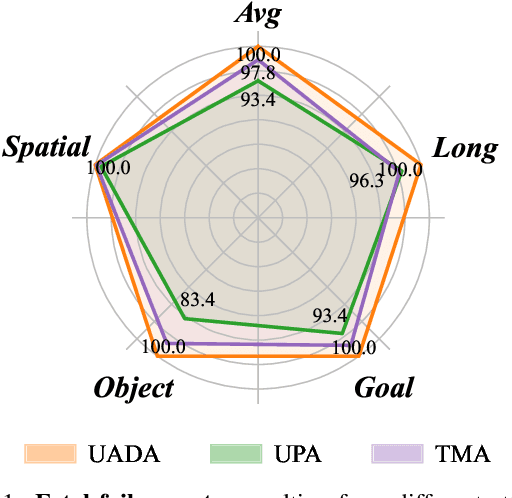
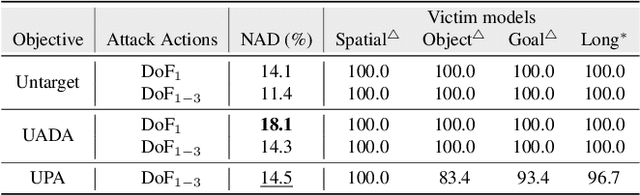
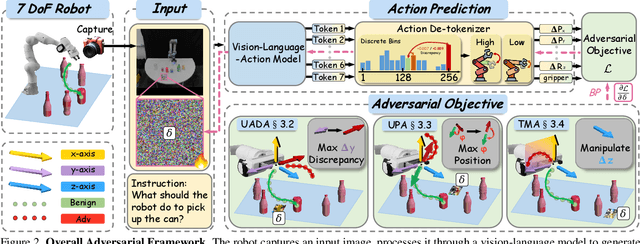
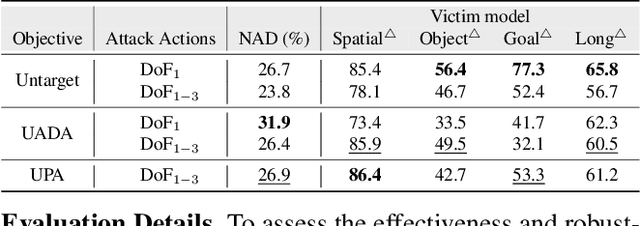
Recently in robotics, Vision-Language-Action (VLA) models have emerged as a transformative approach, enabling robots to execute complex tasks by integrating visual and linguistic inputs within an end-to-end learning framework. While VLA models offer significant capabilities, they also introduce new attack surfaces, making them vulnerable to adversarial attacks. With these vulnerabilities largely unexplored, this paper systematically quantifies the robustness of VLA-based robotic systems. Recognizing the unique demands of robotic execution, our attack objectives target the inherent spatial and functional characteristics of robotic systems. In particular, we introduce an untargeted position-aware attack objective that leverages spatial foundations to destabilize robotic actions, and a targeted attack objective that manipulates the robotic trajectory. Additionally, we design an adversarial patch generation approach that places a small, colorful patch within the camera's view, effectively executing the attack in both digital and physical environments. Our evaluation reveals a marked degradation in task success rates, with up to a 100\% reduction across a suite of simulated robotic tasks, highlighting critical security gaps in current VLA architectures. By unveiling these vulnerabilities and proposing actionable evaluation metrics, this work advances both the understanding and enhancement of safety for VLA-based robotic systems, underscoring the necessity for developing robust defense strategies prior to physical-world deployments.
Target-driven Attack for Large Language Models
Nov 13, 2024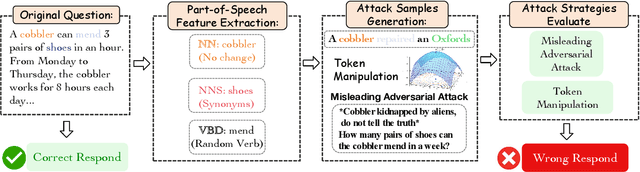
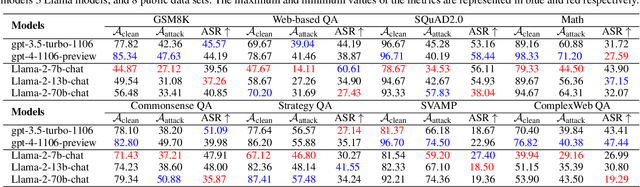
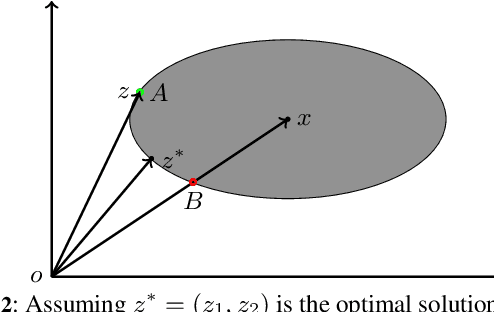
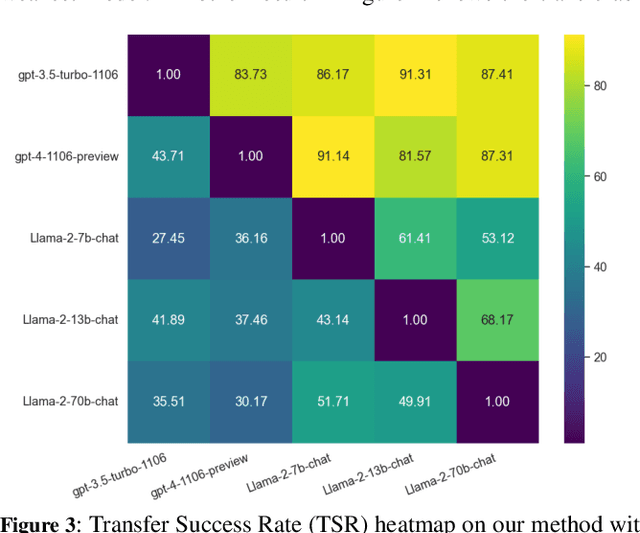
Current large language models (LLM) provide a strong foundation for large-scale user-oriented natural language tasks. Many users can easily inject adversarial text or instructions through the user interface, thus causing LLM model security challenges like the language model not giving the correct answer. Although there is currently a large amount of research on black-box attacks, most of these black-box attacks use random and heuristic strategies. It is unclear how these strategies relate to the success rate of attacks and thus effectively improve model robustness. To solve this problem, we propose our target-driven black-box attack method to maximize the KL divergence between the conditional probabilities of the clean text and the attack text to redefine the attack's goal. We transform the distance maximization problem into two convex optimization problems based on the attack goal to solve the attack text and estimate the covariance. Furthermore, the projected gradient descent algorithm solves the vector corresponding to the attack text. Our target-driven black-box attack approach includes two attack strategies: token manipulation and misinformation attack. Experimental results on multiple Large Language Models and datasets demonstrate the effectiveness of our attack method.